Answering a question in seconds doesn't make a machine a teacher. A personal teaching robot would need to read a learner's work, spot the error, choose the next task, and know when its advice is wrong.
For families, schools, and training teams, friendly conversation is only one part of the test. The useful proof is whether the robot can help one person learn a skill over time.
- Conversation is the easy part: teaching needs checks, feedback, and memory.
- The robot needs a body: it must read paper, point to objects, or show a physical step.
- Safety sets the limit: a system working near children needs clear controls and human review.
What a teaching robot would have to do
A personal teacher starts with a learner model. That means a record of what the person knows, where they made mistakes, and which task should come next. A chat system can store answers, but storage alone doesn't prove that the learner understood the lesson.
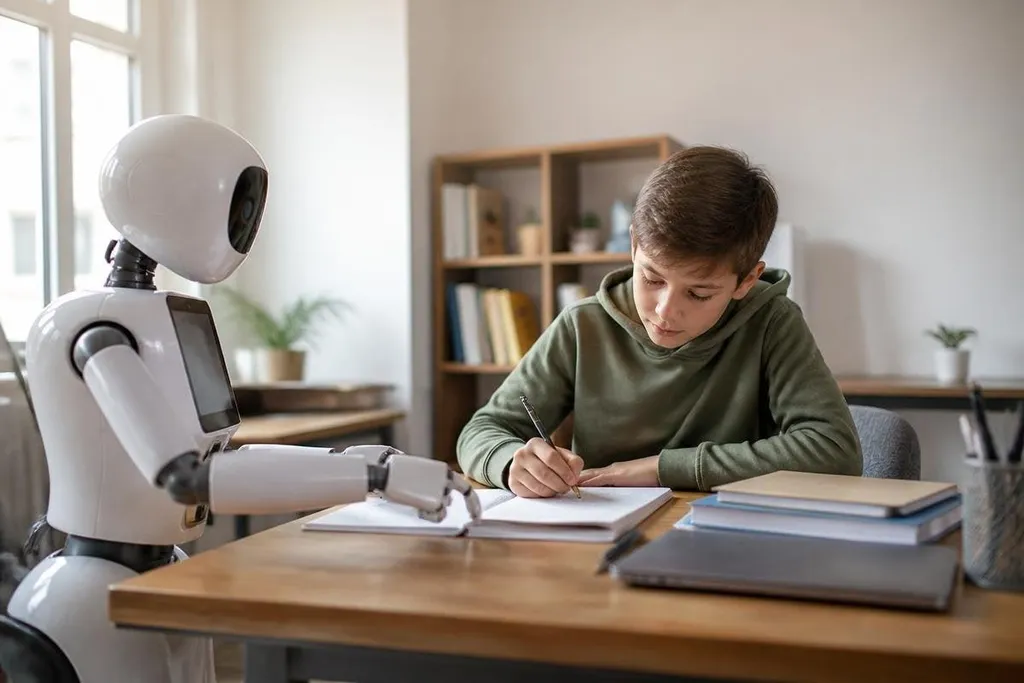
The robot would need several ways to check that. It might read handwriting through a camera, listen to a spoken answer through a microphone, or watch a physical task with depth sensing. Each method has gaps: handwriting can be hard to read, speech can hide guessing, and a camera may miss a small hand movement.
The next step is feedback. Good feedback points to the part that needs work and gives the learner a chance to try again. Giving the answer every time may finish the worksheet faster while teaching less.
Physical teaching adds another layer. When the robot shows a soldering step, a lab procedure, or a tool change, it needs controlled motion, a safe speed, and a way to stop when a person reaches into its work area. That is a robotics problem, not a chat feature.
Where the robot could help
A system with speech, cameras, and a moving arm could support repeated practice. It could ask a learner to sort parts, read a passage aloud, identify a fault, or repeat a machine setup while recording the result.
That model fits skills where the robot can check a clear outcome. It is less useful when success depends on taste, trust, or a long conversation about a learner's home life. A teacher can notice fear, boredom, or confusion from context that a sensor may miss.
The hardware also changes the cost. A classroom tablet can reach many pupils at once.
A mobile robot serves fewer people at a time, needs charging, and may need a trained person nearby when its movement or lesson goes wrong.
That extra support makes the robot’s software and lesson results as important as its wheels and battery. A dated report from Robot24 can put a robot’s claimed teaching role beside its tested task and human handoff.
The limits that matter
A personal teacher robot could sound certain while giving a wrong answer. That risk grows when the lesson covers health, safety, electrical work, or any skill where a mistake can cause harm. The system needs a clear way to show its source, flag doubt, and hand the lesson to a person.
Privacy is another hard limit. A robot that records speech, video, and schoolwork can build a detailed picture of a learner. Any real deployment needs clear rules for storage, deletion, access, and consent before the robot enters a home or classroom.
Repeated drills only help when the task matches the learner's level. A lesson that stays too easy wastes time; one that jumps too far may leave the person guessing.
No supplied evidence shows that a current personal robot can handle this full job. I'd wait for results from long classroom or home trials before treating one as a teacher rather than a practice device.
A buying and testing checklist
Use these checks before you put a teaching robot in front of a learner:
- Name the skill: write down the task the robot must teach and the result that counts as success.
- Check its proof: ask how it scores answers, movement, speech, or written work.
- Watch the handoff: confirm that a person can pause the lesson and take control.
- Set data rules: record what sensors collect, where files go, and when they are deleted.
- Test bad answers: see how the robot reacts when the learner guesses, refuses, or asks something outside the lesson.
A personal teacher robot becomes useful when it can connect a learner's action to the next safe exercise, show why that exercise fits, and call for human help when the evidence is weak. Until trials show that pattern over weeks rather than a short demonstration, the sensible role is a practice partner with limits, not a replacement for a teacher.